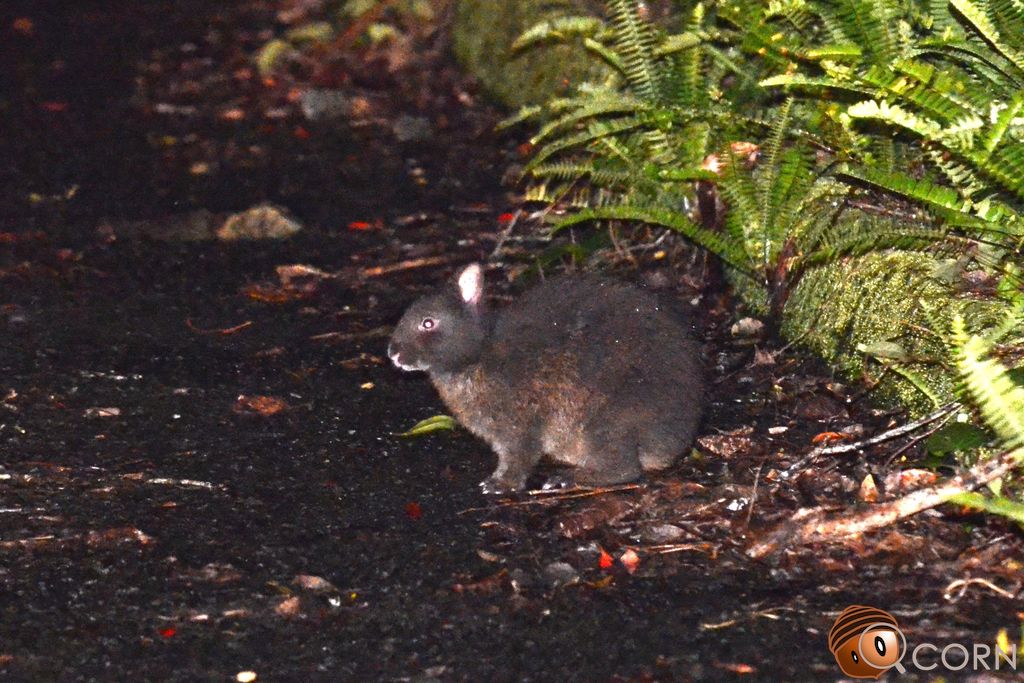
Species information
Scientific name: Pentalagus furnessi
Japanese name: アマミノクロウサギ
Chinese name: 奄美黑兔、琉球兔、奄美短耳兔
English name: Amami rabbit
Origin: Tokunoshima, Amami Oshima
Ecology and description
Amami rabbit is the only species in the genus Pentalagus. It has short ears and claws suitable for digging. It is exclusively found on Tokunoshima and Amami Oshima. Primarily nocturnal, it feeds on various plants.
Currently, the closest relatives of the genus Pentalagus are the extinct Pliocene rabbits of the genus Pliopentalagus. To date, 3 extinct species have been discovered in Anhui, China: Pl. huainanensis, Pl. dajushanensis, and Pl. anhuiensis.
Field photographs taken during our tours, with observation dates
Conservation of Amami rabbit
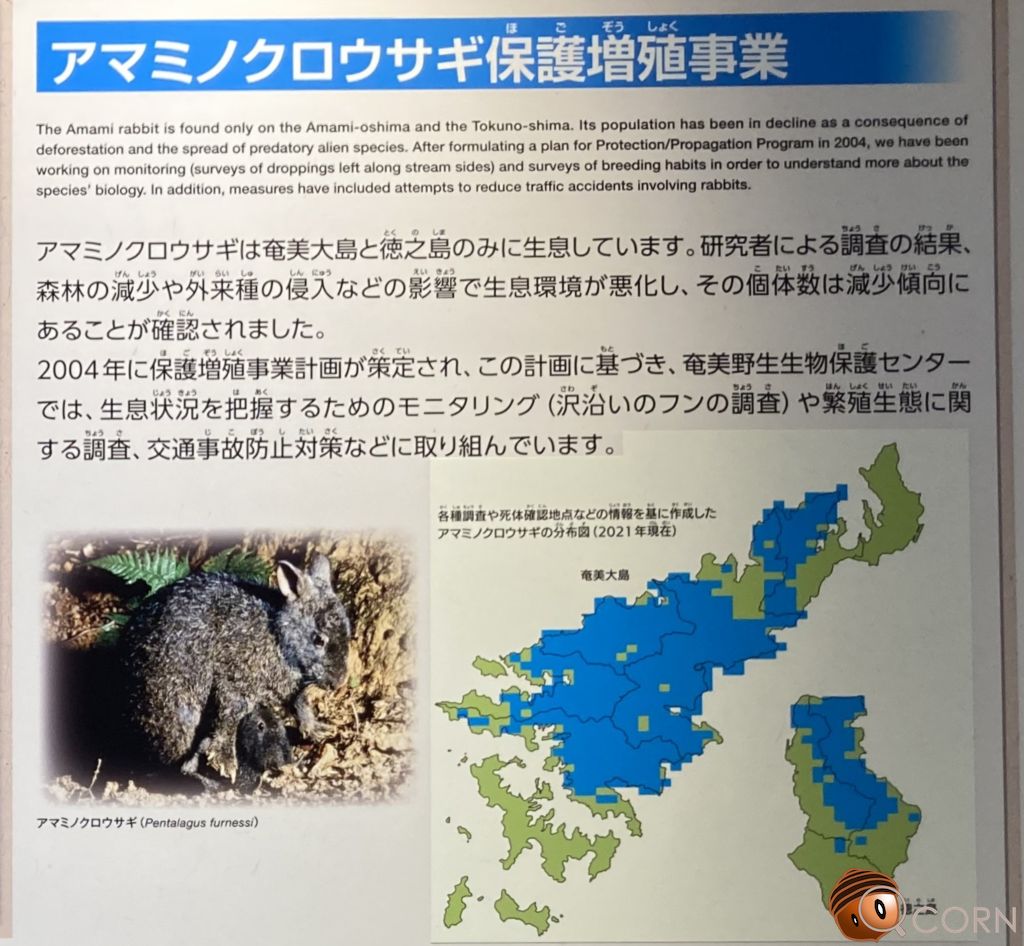
Due to conservation efforts such as the removal of invasive species, the population of Amami rabbit is currently stable, making it not difficult to observe them. The image below shows a display from the Ministry of the Environment’s facility “Amami Wildlife Conservation Center,” which features a distribution map of Amami rabbit based on feces surveys. It indicates a wide distribution range, with reports from February 2023 estimating a population of around 20,000 individuals.
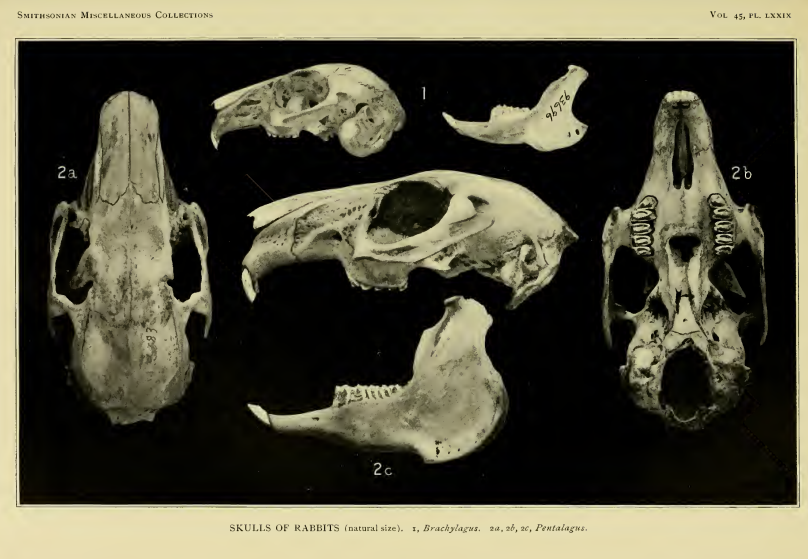
Meaning of the Genus Name Pentalagus
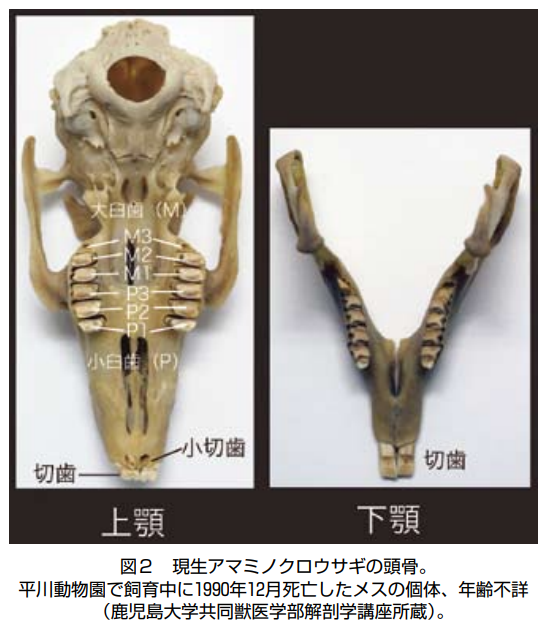
When the genus Pentalagus was established by Lyon in 1904, it was based on a type specimen with 5 molars on each side of the upper jaw. Thus, the genus name incorporates the Greek penta- (five). However, later studies revealed that the “5 molar” trait is not common among Amami rabbit. Most individuals possess 6 cheek teeth on the upper jaw, like other leporids; early descriptions mistakenly maintained the “5 molar” narrative, corrected by research in 1980.
Reference:
Otsuka, J., Toyomitsu, Y. & Nishinakagawa, H. (1980).
Linear measurements of the bones of Lepus brachyurus brachyurus Temminck, Pentalagus furnessi Stone and Oryctolagus cuniculus Linnaeus (JW-NIBS). I. On the cranium and ossa trunci (author’s transl).
Jikken Dobutsu (Experimental Animals), 29(4): 441–455.
Reference (below image):
Amami Wildlife Conservation Center Newsletter “Amami’s Wind News” Issue 40, March 31, 2011
https://ja.wikipedia.org/wiki/アマミノクロウサギ
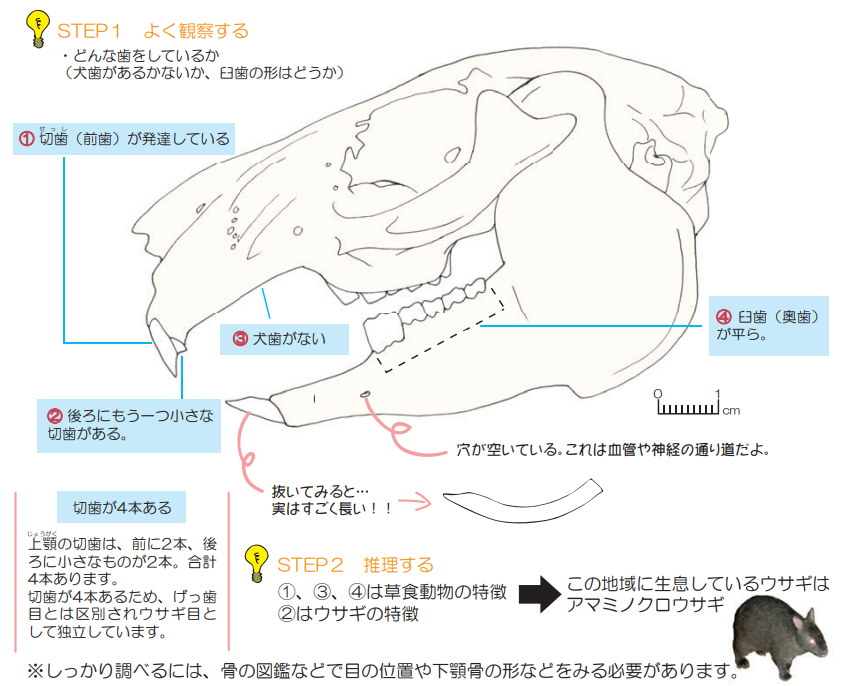
Reference (below image):
Skull of the extant Amami rabbit
Kazuhiko, K., Otsuka, H. “Special Exhibit ‘First in the World: Fossil of Amami Rabbit Discovered on Tokunoshima’.” University of Kagoshima General Research Museum, no. 38, 2016, p. 2.
Reference (below image):
Lyon, Marcus Ward, Jr. Classification of the Hares and Their Allies. Smithsonian Miscellaneous Collections, vol. 45, no. 2, 1904, pp. 321–447.