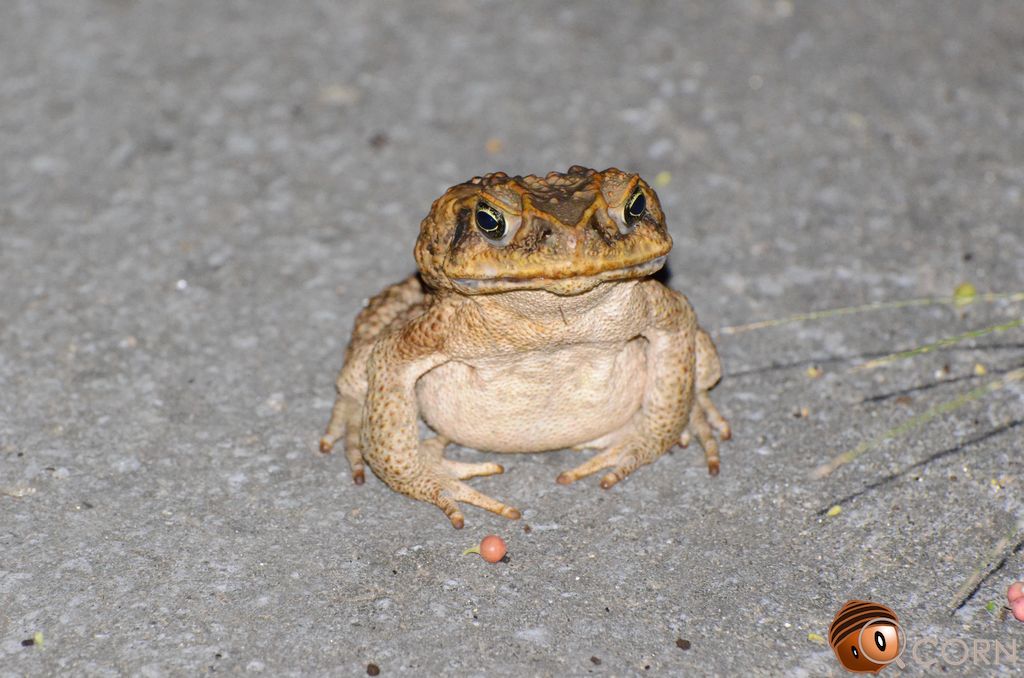
Species information
Scientific name: Rhinella marina
Japanese name: オオヒキガエル
Chinese name: 海蟾蜍、蔗蟾
English name: Cane toad, Marine toad
Origin: Southern Texas, Central America, northern South America
Ecology and description
The cane toad, also called the marine toad, is native to the Americas and measures 9–15cm in length. It is carnivorous, preying on insects, land snails, millipedes, small mammals and frogs. A single clutch contains 8,000–25,000 eggs, and its large parotoid glands secrete toxin.
To control sugarcane pests, Japan introduced the cane toad to the Daito Islands and Ishigaki, while the Ogasawara population was brought from Saipan to Chichijima in 1949. It is now established in the Ogasawara Islands, the Daito Islands and Ishigaki, and is designated as a specified invasive alien species, with introduction, keeping and transport prohibited. It preys on small ground-dwelling animals and competes with frogs and lizards for food, and its toxin may also affect predators.
On Iriomote, individuals were captured repeatedly in 2000–2007 and in 2017, but no established population has been confirmed. The 2017 individual is thought to have arrived again with materials. On Okinawajima, the toad was found around Urasoe in 2011 and about 700 were captured, but none has been confirmed since fiscal year 2017.
References:
National Institute for Environmental Studies Invasive Species Database
Okinawa Prefecture: cane toad document
Ministry of the Environment: cane toad on Iriomote document
Field photographs taken during our tours, with observation dates